By Stacy A. Bonos, Eric MacPherson and Juan Gonzalez
During milder winters in the northeast, which are becoming more prevalent, some golf courses remain open through the winter. These golf courses generally have bentgrass playing surfaces for greens and fairways. Increased winter play increases wear associated stress on the dormant bentgrass; however, the severity of winter wear stress and recovery period remain unknown.
A study was conducted to answer several research objectives:
- Evaluate whether there are significant cultivar differences in creeping bentgrass response to winter wear stress and recovery.
- Identify high through-put phenotyping traits correlated with visual winter wear damage and recovery ratings using RGB (red-green-blue) and multispectral images captured by a UAV.
- Evaluate the potential to use multispectral images to predict winter wear performance among breeding lines.
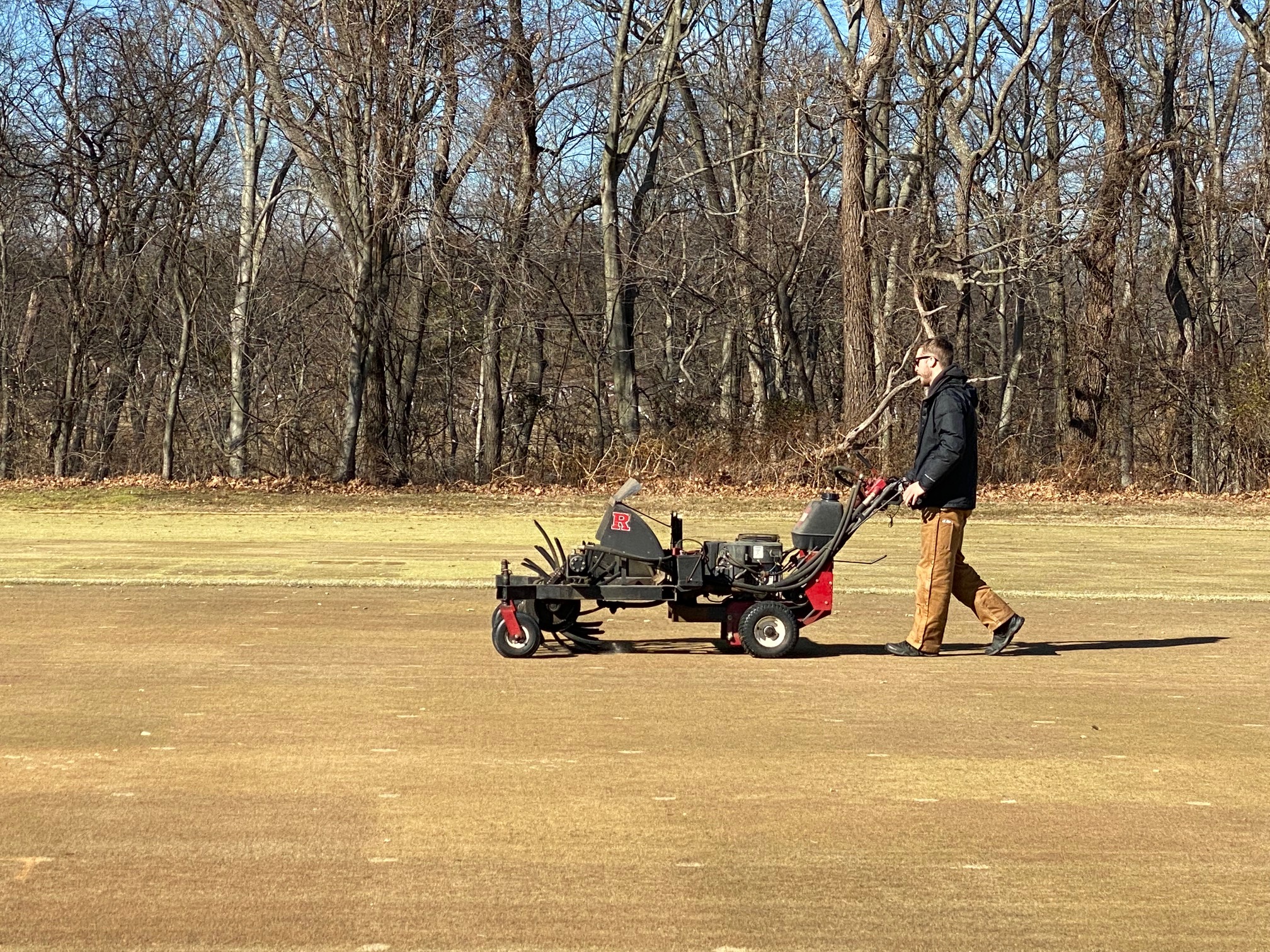
During the winters of 2023-24 and 2024-25, winter wear was applied to bentgrass greens and fairway trials using the Rutgers Wear Simulator (Figure 1). In 2023-24, 26 passes were applied from February to March, and in 2024-25, 31 passes were applied from January to March. when conditions were favorable to golf (temperatures over 40◦ F). Visual ratings on winter wear damage and spring recovery were taken. Monthly UAV flights were also conducted using a DJI Mavic 3M (Figure 2).

Visually rated creeping bentgrass cultivars and selections showed significant differentiation in response to winter wear and wear recovery. RGB and multispectral images obtained by the UAV were then processed and analyzed for over 700 traits using turfCV, a computer vision pipeline. These traits were then correlated to the visual winter damage and recovery ratings. Several traits including saturation (hsv_s) and NDVI had high correlations with visual ratings, successfully identifying cultivars and selections that performed both well and poorly. UAV imaging was demonstrated to have sufficient ability to detect cultivar and selection level differences, allowing for its implementation in future selecting. UAV imaging will allow for greater, more efficient data collection across a wider diversity of generated traits, while freeing up the breeder to perform other tasks. It also eliminates the need to have a visual rater out in the field in unfavorable conditions.
Results

Creeping bentgrass cultivars varied significantly in winter wear quality and recovery. Cultivars with improved winter wear quality in both the putting green and fairway trials were: Piper (Figure 3), Oakley, Spectrum, 007XL, Coho, Prodigy, and experimental lines WDF4, WDP2, WDP1, and WDF2. AU Victory (Figure 4), Penn A-4, Penncross and Declaration had poor winter wear quality. Relatively high heritability estimates were observed for winter wear quality and recovery visual ratings.

UAV derived image analyses were able to show significant differences in the bentgrass wear tolerances which were consistent with visual ratings. UAV derived rankings showed strong correlation with visual rankings in putting greens, and moderate correlation with fairways. Cultivars that ranked in the top 30% were consistent between visual ratings for wear quality and recovery and UAV derived HTP data indicating that HTP data collected via UAVs may be used to predict winter wear performance.